Plant Hardiness Zones
Understanding your hardiness zone is essential for successful gardening. It helps you choose plants that will thrive in your local climate.
Unlike the USDA system, which is based solely on average annual minimum winter temperature, the Canadian system uses seven climate variables: mean January temperature, mean maximum July temperature, mean July rainfall, mean annual rainfall from June to November, maximum snow depth, frost-free period, and mean January wind speed.
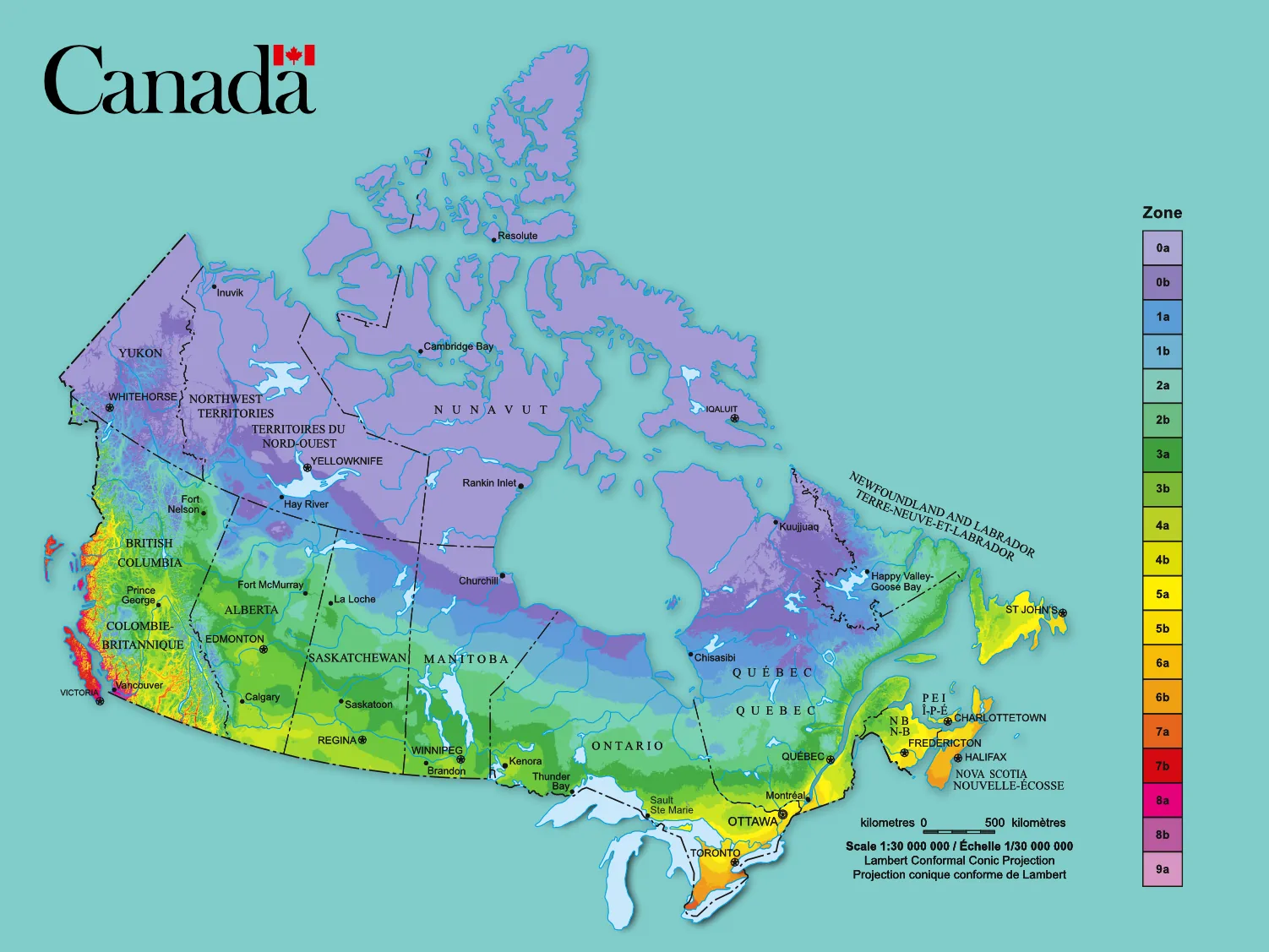
Canadian zones run from 0 (coldest, covering arctic and subarctic regions) to 9 (warmest, found along the southern BC coast and Vancouver Island). Each zone is also divided into “a” and “b” subzones for greater precision.
Because the Canadian system accounts for more variables than minimum temperature alone, a Canadian zone and a USDA zone with a similar number are not directly equivalent. Always check plant tags against the zone system used where the plant information was published.
On the official site, you can search by postal code to find your exact Canadian hardiness zone, including subzone (a or b).
Zone Descriptions
Examples: Nunavut, NWT, parts of Yukon
Examples: Northern Manitoba, Saskatchewan, Alberta
Examples: Central prairies, northern Ontario
Examples: Southern prairies, northern Ontario and Quebec
Examples: Parts of Ontario, Quebec, BC interior
Examples: SW Ontario, Montreal area, BC interior
Examples: Toronto, Ottawa, parts of BC
Examples: Niagara region, southern BC, Okanagan
Examples: BC coast, Vancouver Island
Examples: Victoria, Nanoose Bay
Using Canadian Hardiness Zones for Gardening
When selecting plants for your Canadian garden, look for hardiness zone ratings that match your zone or are lower (colder). Canadian seed catalogues and plant nurseries typically use the Canadian zone system, while American sources use the USDA system.
Tips for Canadian Gardeners
- Check the source: Canadian and American nursery catalogues use different zone systems. A plant rated “Zone 5” in a Canadian catalogue is not the same as “Zone 5” in a USDA context.
- Use subzones: The “a” and “b” subzones add precision — “a” is slightly colder within a zone. Check your postal code on the official map for your subzone.
- Consider microclimates: Urban heat islands, proximity to water, and local topography can shift your effective zone by half a zone or more.
- Snow cover matters: The Canadian system accounts for snow depth because a deep, consistent snowpack insulates plant roots from extreme cold.
Plants for Your Zone
Explore our plant guides to find vegetables and fruits that are well-suited to your hardiness zone.